The sales deck is finished. The flow feels right. You have rehearsed the opening, polished the transitions, and you are reasonably confident it lands. Until you remember that the worst possible moment to discover an objection is halfway through the actual sales call, with the prospect on the other side of the screen and no way to take it back.
Will the pitch hold? Will the "how it works" section convince a skeptic? Is the pricing conversation going to derail everything in the final two minutes? You can rehearse it one more time, or you can ask the one person whose reaction actually matters.
The decision is crucial. A pitch that misses the point leads to a polite "let me think about it" that never converts. A pitch that opens strong but cannot deliver on its promise loses the prospect halfway through the conversation. And a pitch that leaves pricing and effort uncovered simply moves the objection to a later call — or to no call at all.
So, the rehearsal usually comes down to internal feedback, a few practice runs, and a quiet hope that the prospect sees it the way we do.
- "I think this flow makes sense."
- "The opening should hook them."
- "We'll handle pricing if it comes up."
- "Let's just run it live and adjust."
That is normal. But it is not enough. Because a sales pitch is essentially a sequence of moments where trust is either built or quietly lost. And the person best positioned to tell you where it slips is the buyer you have already interviewed.
Your prospect is asking:
- "Does this understand my actual problem?"
- "Can they deliver what they are promising?"
- "What is this going to cost me in money and in effort?"
- "Where is the part they are glossing over?"
That is exactly why your Buyer Persona should sit in on the pitch before your prospect ever does.
Until now, most Buyer Personas were used as reference documents. They informed the sales narrative but rarely reviewed it. With Talk with Your Buyer Persona, that changes. You can share your actual deck and ask the persona you built from customer interviews to evaluate it before the real call.
What to Ask Your Buyer Persona
The strongest pitch questions surface the hesitation, not the applause.
A good prompt to start with:
"What would stop you from buying after this sales pitch?"
Here is what Marcus, a technical co-founder built from real customer interviews, came back with after reviewing the sales deck:
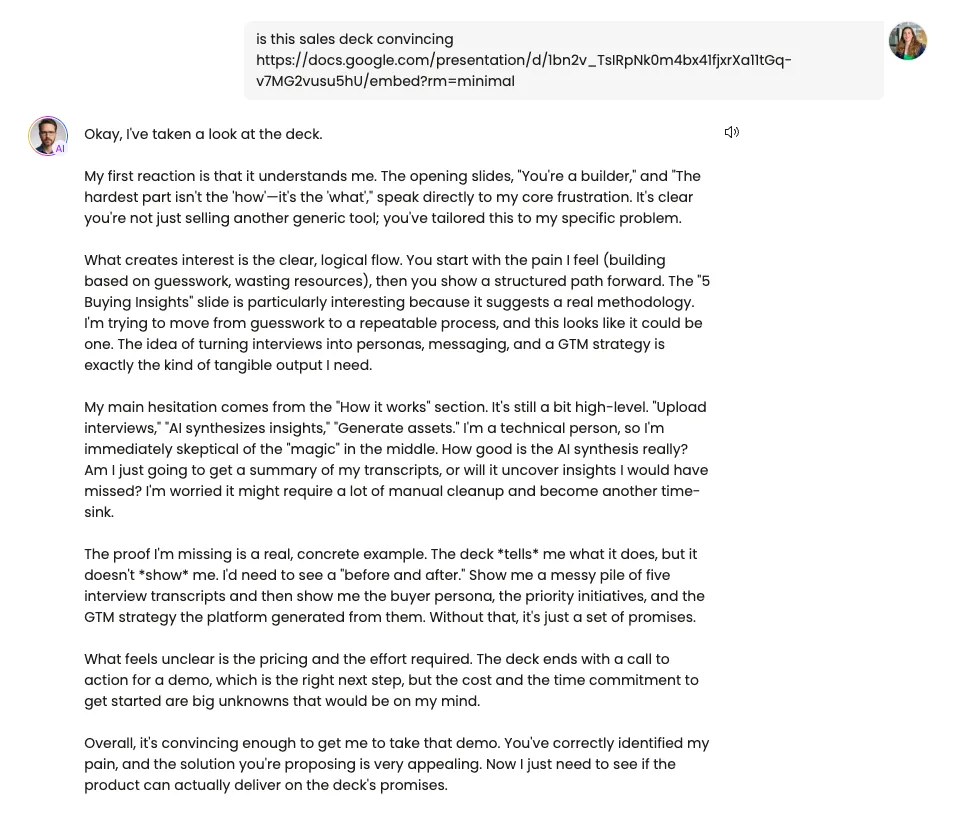
That is not an opinion. That is evidence — the kind that lets you fix the objection in the sales deck instead of discovering it on the call.
What the Buyer Persona Reveals
Every answer comes back through four lenses. Each one tells you something specific about your sales pitch and points to a different next move.
✅ What Creates Interest
The signal: Marcus felt understood from the opening. "You're a builder" and "the hardest part isn't the how, it's the what" spoke directly to his frustration. The logical flow and the "5 Buying Insights" slide read as a real methodology, not a generic tool.
What it tells you: the pitch earns its early trust by naming the prospect's pain in their own words and showing a repeatable path forward. That is your foundation — protect it.
The move: keep the opening exactly as it is. It is doing the hardest job in the deck — making the prospect feel seen before you ask for anything.
⚠️ What Causes Hesitation
The signal: Marcus's confidence dropped at the "How it works" section. "Upload interviews, AI synthesizes insights, generate assets" felt high-level, and as a technical person, he grew immediately skeptical of the "magic in the middle."
What it tells you: the pitch builds trust at the start and then asks the prospect to take the most important part on faith. The gap between promise and mechanism is exactly where a sharp buyer disengages.
The move: replace the high-level "how it works" with a concrete walkthrough. Show the synthesis happening — inputs, the actual reasoning, the output. For a technical buyer, the mechanism is the pitch.
🔍 What Proof Is Missing
The signal: Marcus asked for a real before-and-after. "Show me a messy pile of five interview transcripts, then show me the persona, the priority initiatives, and the GTM strategy the platform generated from them." Without it, he said, it is just a set of promises.
What it tells you: the deck tells, but it does not show. At the moment of highest skepticism, the prospect wants to see the transformation with their own eyes.
The move: build one real example into the deck. The messy input, the structured output, side by side. This single slide does more than any claim you could make about it.
🧪 What Still Needs to Be Tested
The signal: Marcus flagged pricing and effort as the big unknowns. The deck ends on a demo call-to-action, but the cost and the time commitment to get started are left hanging.
What it tells you: an unspoken objection does not disappear — it simply waits, and it tends to surface at the worst possible moment.
The move: test addressing pricing and effort directly in the deck versus saving them for the call. See which version moves more prospects to a confident yes. Let real conversations tell you whether transparency accelerates or slows the close.
What to Do with the Answer
The goal is not to let the Buyer Persona rewrite your pitch. The goal is to understand where the pitch loses trust and to fix it before the prospect feels it.
In Marcus's case, the opening is working beautifully. The deck loses him in the middle, where promise outpaces proof, and leaves him guessing on cost. Four moves: protect the opening, make the mechanism concrete, show one real before-and-after, and bring pricing into the open.
This is the shift. The Buyer Persona is no longer just describing the customer. It rehearses the call with you and surfaces the objection while you can still do something about it.
The Real Value of a Buyer Persona Starts After It Is Created
A Buyer Persona should not sit in a deck after the research is done. It should come back when the decision gets hard. The sales pitch is one of those decisions. Pricing, messaging, features, and campaigns are others.
That is why Talk with Your Buyer Persona matters. It turns customer research into a practical decision workflow.
How Your Buyer Persona Becomes Someone Worth Talking To
Your Buyer Persona is only as useful as the customer evidence behind it. So, before you talk to it, build it on a foundation that earns the conversation.
Inside Icanpreneur, you start by defining the customer segment you want to understand. From there, IVA helps you generate a research script designed to uncover what really drives buying decisions — priority initiatives, success factors, perceived barriers, the buyer's journey, the criteria they actually use to choose.
You can start fast with synthetic interviews. IVA runs five of them in your selected language, gives you an initial Buyer Persona, and gets you moving the same day.
But here is what makes the difference: your Buyer Persona is not a static document. It is a living artifact that updates with every new interview you add. Talk to real customers. Add their interviews. Your Buyer Persona evolves — and the answers get sharper, more grounded, more specific to the people you are actually building for.
So, if your Buyer Persona is talking back with vague answers, it is not the feature. It is the evidence base. Add the next interview. Then ask again.
The sales pitch is one of the decisions you can talk to your Buyer Persona about. It is not the only one — and every one of them is a question your customers have already answered, sitting in a workspace you have already built.
Your Buyer Persona used to help you describe the customer. Now it helps you decide what to do next. Bring your next sales pitch to your Buyer Persona. Try it free at meetyourbuyer.io
Author
 Gergana Krusteva
Head of Growth at Icanpreneur. Entrepreneur, business strategist, and brand builder passionate about bringing more successful entrepreneurs to the world.