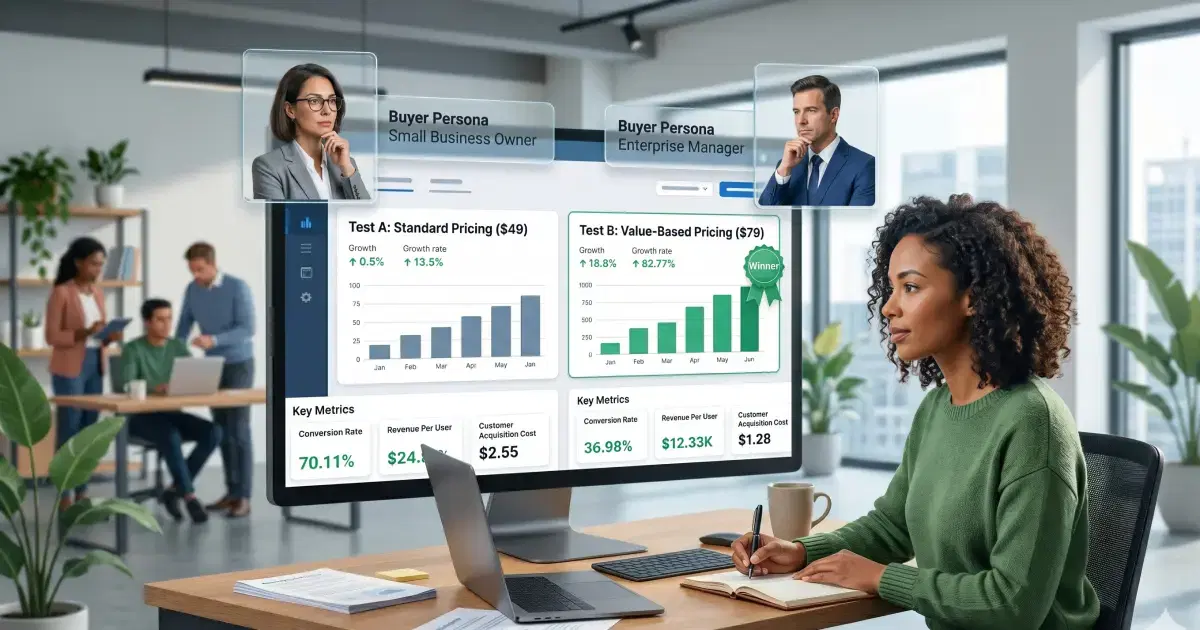
The pricing page is open in one tab. The competitor research is in another. There is a number in the box — and the cursor has been blinking next to it for a while.
Is €29 too cheap? Does €49 sound too premium? Should it be €48 because of something you read once about price psychology?
The decision matters. Get it wrong on the low side and the business is weaker than it should be from day one. Get it wrong on the high side and demand never shows up, leaving you with no signal at all. Get it vague and you end up copying competitors without knowing whether your buyers see the same value they do.
So, the call usually comes down to a mix of competitor research, internal debate, and gut feel.
- "€29 feels safe."
- "€49 sounds a bit premium."
- "Maybe we should start low and increase later."
- "What are similar tools charging?"
That is normal. But it is not enough. Because pricing is not just a number — it is a test of perceived value. And the people best positioned to tell you whether that value lands are the customers you already interviewed.
Your buyer is asking:
- "Is this worth it for me?"
- "Do I trust the outcome?"
- "What risk does this remove?"
- "What would I have to believe before paying?"
- "What am I already spending time or money on instead?"
That is exactly why your Buyer Persona should be part of the pricing decision — but not in the way most founders use it.
Until now, most Buyer Personas were used as reference documents. They helped teams understand the customer but rarely showed up when the pricing page was being written. With Talk with Your Buyer Persona, that changes. You can bring the pricing decision directly to the Buyer Persona you built from customer interviews — and derive a number from the evidence behind it.
Why Asking "Does This Price Feel Right?" Is the Wrong Question
The instinct is to put a number in front of the persona and ask for a reaction. "Would €49/month feel like a no-brainer?" It seems like a reasonable test. But it is not — because it asks the buyer to evaluate your number in a vacuum.
Buyers do not think about price in a vacuum. They think about it relative to what they are already spending, what they are already losing, and what it would cost them to keep doing things the way they are doing them now. When you ask for a reaction to your number, you get an opinion. When you ask about their current reality, you get a benchmark.
The benchmark is what you actually need.
The Three Questions That Give You a Number
Instead of presenting a price and asking the persona to evaluate it, ask three questions that surface the economics already sitting in the customer's life.
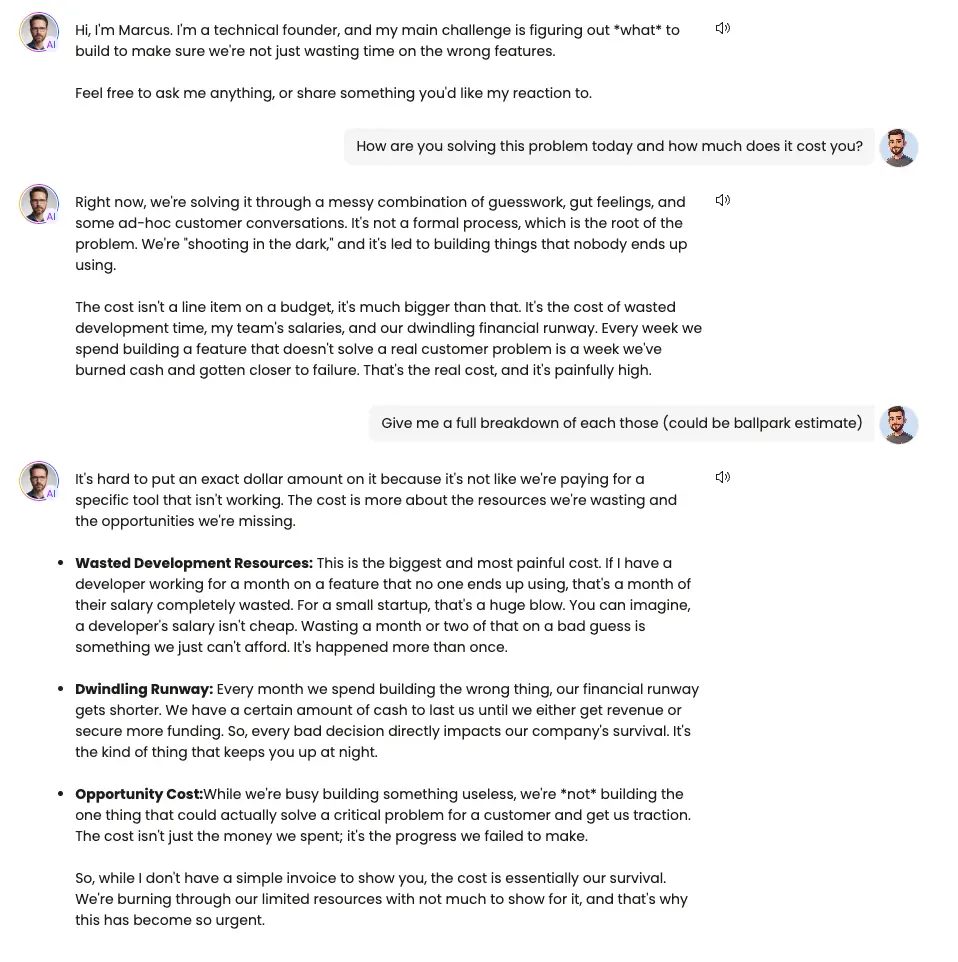
Question 1: How are you solving this problem today?
Every problem your product solves is already being solved somehow — manually, expensively, imperfectly, or not at all. The persona's answer tells you what you are actually competing against. Not the competitor in your pitch deck. The real alternative the buyer uses right now.
For Marcus, a technical co-founder built from real customer interviews, the answer is a combination of founder time spent running manual analysis, guessing at what to build, and occasionally hiring a consultant to validate assumptions. None of it is labeled "market research budget." All of it is a real cost.
Question 2: What does that solution cost you?
This is where the benchmark forms. The answer is rarely a clean monthly line item — it is usually time, opportunity cost, and the occasional external spend. Ask the persona to be specific: how many hours per week, at what effective hourly rate, with what tools or services on top.
When Marcus adds it up — two to three hours per week of founder time to gather and interpret customer signals, plus the cost of building in the wrong direction for a month before realizing — the number is not €49. It is considerably larger. And that number exists whether or not he pays for your product.
Question 3: What is the cost of not solving this optimally?
This is the opportunity cost question. Not "what does the bad solution cost" — but "what does the gap between the bad solution and a good one cost you?"
For Marcus, the gap is the difference between guessing what to build and knowing. One wrong sprint is two weeks of a developer's time. One wrong feature prioritization can misalign the product for a quarter. One missed insight from a customer interview can mean a pivot that costs months. The cost of not having a reliable signal is not a subscription fee — it is a compounding drag on the runway.
How to Use the Answers to Arrive at a Price
Once you have the three answers, the pricing logic becomes straightforward.
Your price should be meaningfully less than what the buyer is already spending on the problem — so switching is an obvious financial win. It should be a small fraction of the opportunity cost — so the ROI math is not even a debate. And it should land in a range where the buyer does not need to justify it to anyone, because the alternative is visibly more expensive.
If the current solution costs €400/month in time and the opportunity cost of getting it wrong runs to thousands per quarter, then €49/month is not a number you invented — it is a number that falls out of the customer's own economics. You did not guess it. You derived it.
This is a more defensible pricing decision than any competitor benchmark or gut feel. Not because you asked the buyer what to charge, but because you understood what the problem already costs them.
What This Changes on the Pricing Page
The same three questions also tell you how to write the pricing page.
If you know what the buyer is currently spending, you can show the comparison explicitly. If you know the opportunity cost of the gap, you can frame the price as a fraction of what is at stake. If you know what the buyer would have to justify internally, you can pre-empt that conversation with the math.
This is the shift. The Buyer Persona is no longer just describing the customer. It gives you the inputs to price with evidence — and to write a pricing page that wins the internal conversation before the buyer even has it.
The Real Value of a Buyer Persona Starts After It Is Created
A Buyer Persona should not sit in a deck after the research is done. It should come back when the decision gets hard. Pricing is one of those decisions. Messaging, features, campaigns, sales pitches, and website copy are others.
That is why Talk with Your Buyer Persona matters. It turns customer research into a practical decision workflow.
How Your Buyer Persona Becomes Someone Worth Talking To
Your Buyer Persona is only as useful as the customer evidence behind it. So, before you talk to it, build it on a foundation that earns the conversation.
Inside Icanpreneur, you start by defining the customer segment you want to understand. From there, IVA helps you generate a research script designed to uncover what really drives buying decisions — priority initiatives, success factors, perceived barriers, the buyer's journey, the criteria they actually use to choose.
You can start fast with synthetic interviews. IVA runs five of them in your selected language, gives you an initial Buyer Persona, and gets you moving the same day. That alone is enough to start asking questions that would have taken weeks to answer otherwise.
But here is what makes the difference: your Buyer Persona is not a static document. It is a living artifact that updates with every new interview you add. Talk to real customers. Add their interviews to the same research. Your Buyer Persona evolves — and the answers you get when you talk to it get sharper, more grounded, more specific to the people you are actually building for.
Synthetic interviews give you the signal to start. Real customer interviews turn that signal into evidence you can stake decisions on. The Buyer Persona becomes more useful the more interviews you do.
So, if your Buyer Persona is talking back with vague answers, it is not the feature. It is the evidence base. Add the next interview. Then ask again.
Pricing is the first decision you can talk to your Buyer Persona about. It is not the last. The decisions that follow — messaging, features, campaigns, sales pitches, websites — get sharper for the same reason. Every one of them is a question your customers have already answered, sitting in a workspace you have already built.
Your Buyer Persona used to help you describe the customer. Now it helps you decide what to do next.
Author
 Vesko Kolev
Founder & CEO of Icanpreneur. Passionate about connecting people with their purpose of becoming successful entrepreneurs.