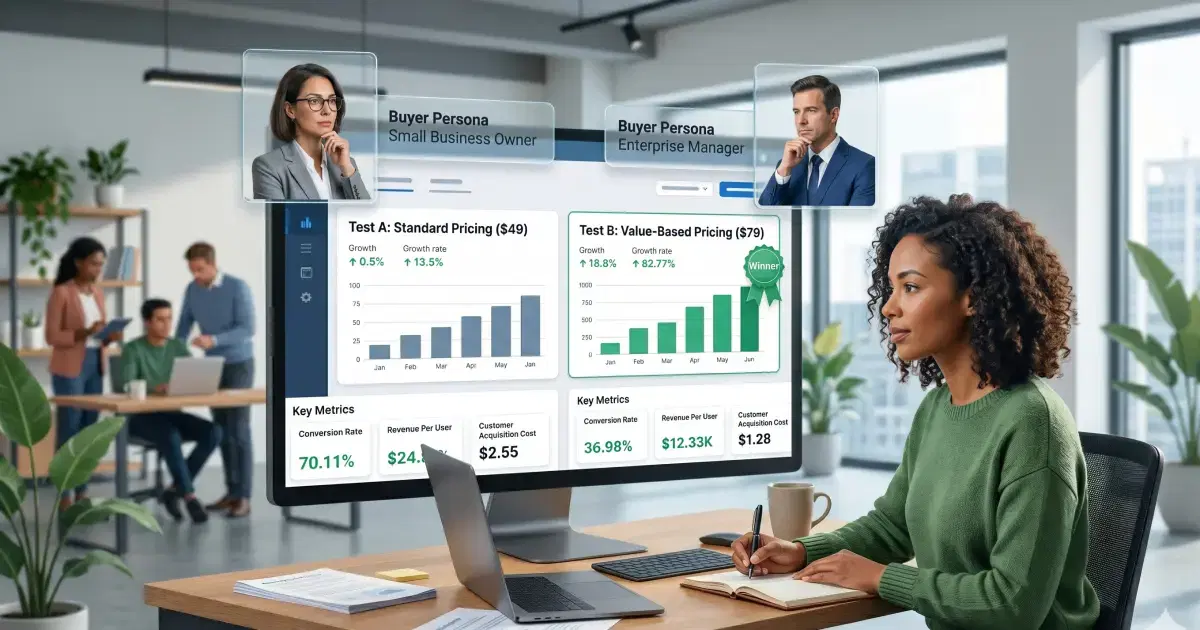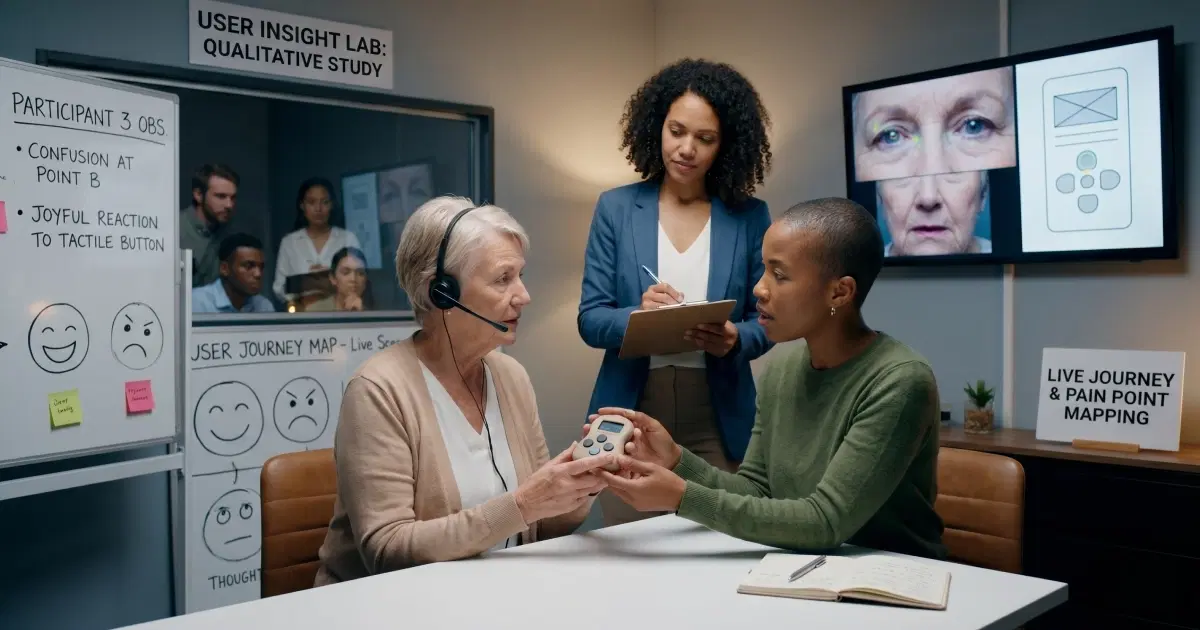
The product roadmap is open on screen. Two features are competing for the next sprint. The engineering lead wants to ship one. The customer success lead wants the other. The CEO has not weighed in yet.
Is German localization the one that earns the build? Or is pitch deck generation the one customers will actually use more often? Should we ship both? Should we have built something else entirely?
The decision matters. Get the feature wrong and you burn weeks of engineering on something nobody opens. Get the priority wrong and the feature your customers were really waiting for slips another quarter. Get it vague and your roadmap becomes a list of half-built ideas that compete for attention long after the original intent has faded.
So, the call usually comes down to a mix of sales requests, competitor scans, and whichever feature has the loudest internal sponsor.
- "Three customers asked for this last month."
- "Our biggest deal mentioned it on the demo call."
- "Everyone else in the category has it."
- "Let's just ship it and see."
That is normal. But it is not enough. Because a feature is not just a capability — it is a bet on what creates ongoing value. And the people best positioned to tell you whether that bet pays off are the customers you have already interviewed.
Your buyer is asking:
- "Will I actually use this every week?"
- "Does this solve a problem I think about often?"
- "Is this tied to something my business depends on?"
- "Will this save me work, or create more?"
That is exactly why your Buyer Persona should be part of the product feature decision.
Until now, most Buyer Personas were used as reference documents. They informed product strategy decks and roadmap reviews but rarely showed up when the next sprint was being planned. Talk with Your Buyer Persona feature changes that. You can now bring your product decisions directly to the Buyer Persona built from customer interviews and test it against actual evidence.
What to Ask Your Buyer Persona
The strongest feature questions are the ones that surface the use frequency and dependency behind a yes, not just the preference.
A good prompt to start with:
"Would German localization or pitch deck generation make you more likely to use the product every week?"
A useful answer should not simply pick a feature. It should tell you why one feature ties into the buyer's core motivation, what they would worry about if you built it, what they would need to see before adopting it, and where decisions about scope and control still need to be made.
Here is what Marcus, a technical co-founder built from real customer interviews, came back with when asked exactly that question:
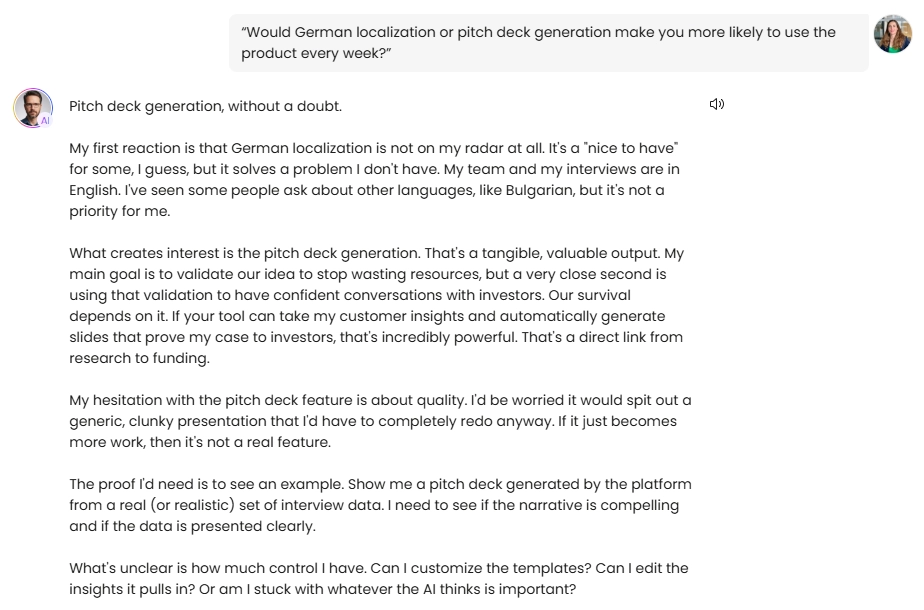
That is not an opinion. That is evidence — the kind that turns a roadmap call into a sharper, more defensible decision.
What the Buyer Persona Reveals
Every answer comes back through four lenses. Each one tells you something specific about your feature and points to a different next move.
✅ What Creates Interest
The signal: Marcus picked pitch deck generation decisively because it connects directly to what his business depends on — confident investor conversations and the funding that follows. He called it a "tangible, valuable output" and named the link explicitly: "a direct link from research to funding."
What it tells you: the winning feature is the one that ties into something the buyer's survival depends on. Pitch deck generation is not just useful — it is wired into a milestone that already drives his weekly behavior.
The move: prioritize the feature that connects to a recurring, high-stakes moment in the buyer's workflow. Build the pitch deck capability into the validation flow itself, so the output of customer interviews leads naturally into the asset he needs for the next investor meeting.
⚠️ What Causes Hesitation
The signal: Marcus is worried the generated pitch deck would be generic and clunky — "if it just becomes more work, then it's not a real feature." The hesitation is not about whether to build it. It is about how well it needs to be built to count.
What it tells you: at this level of expectation, shipping a thin version of the feature is worse than not shipping it at all. A pitch deck that needs to be redone from scratch becomes evidence the product cannot be trusted with high-stakes outputs.
The move: define the quality bar before scoping. The pitch deck has to produce a narrative compelling enough to use in front of investors with light editing — not a template the buyer rebuilds from scratch.
🔍 What Proof Is Missing
The signal: Marcus directly asked to see an example — a pitch deck generated by the platform from real or realistic interview data. He wants to evaluate whether the narrative is compelling and the data is presented clearly.
What it tells you: at this scope of feature, the buyer is not satisfied by description. They want to see the output before they trust the feature — and the way the output is structured matters as much as the fact that it exists.
The move: build a demo example into the launch. A pitch deck generated by the platform from a representative validation flow, featured on the webpage and on demo calls. Make the abstract concrete before the buyer commits to adoption.
🧪 What Still Needs to Be Tested
The signal: Marcus asked how much control he has. Can he customize templates? Edit which insights get pulled in? Or is he stuck with what the AI thinks is important?
What it tells you: feature value is partially gated by control. The same pitch deck capability can land as "this saves me hours" or "this gives me something I cannot use" depending on how much agency the user retains over the final output.
The move: test two versions of the feature — one with full template and insight customization, one with smart defaults and lighter editing. See which version drives weekly use. Let real users tell you whether they want flexibility or speed.
What to Do with the Answer
This is where the feature becomes useful. The goal is not to let the Buyer Persona pick your roadmap for you. The goal is to understand what must be true for the feature to earn weekly use.
In Marcus's case, the prioritization contest already has a winner — pitch deck generation. But the answer goes further than that. It tells you the winning feature comes with some conditions to consider: it has to be of high quality, it has to be backed by a visible example, and it has to give the buyer meaningful control over the output.
If you had only the four lenses without the worked example, you would be left with categories. With the worked example decomposed, you are left with four specific moves for the build: wire the feature into a recurring high-stakes moment, define the quality bar before scoping, ship a demo example with the launch, and test the right level of user control.
This is the shift. The Buyer Persona is no longer just describing the customer. It helps you understand how the customer evaluates your roadmap and what the feature needs to do to earn its place.
The Real Value of a Buyer Persona Starts After It Is Created
A Buyer Persona should not sit in a deck after the research is done. It should come back when the decision gets hard. Feature prioritization is one of those decisions. Pricing, messaging, campaigns, sales pitches, and website copy are others.
That is why Talk with Your Buyer Persona matters. It turns customer research into a practical decision workflow.
How Your Buyer Persona Becomes Someone Worth Talking To
Your Buyer Persona is only as useful as the customer evidence behind it. So, before you talk to it, build it on a foundation that earns the conversation.
Inside Icanpreneur, you start by defining the customer segment you want to understand. From there, IVA helps you generate a research script designed to uncover what really drives buying decisions — priority initiatives, success factors, perceived barriers, the buyer's journey, the criteria they actually use to choose.
You can start fast with synthetic interviews. IVA runs five of them in your selected language, gives you an initial Buyer Persona, and gets you moving the same day. That alone is enough to start asking questions that would have taken weeks to answer otherwise.
But here is what makes the difference: your Buyer Persona is not a static document. It is a living artifact that updates with every new interview you add. Talk to real customers. Add their interviews to the same research. Your Buyer Persona evolves — and the answers you get become sharper, more grounded, and more relevant.
Synthetic interviews give you the signal to start. Real customer interviews turn that signal into evidence you can stake decisions on. The Buyer Persona becomes more useful the more interviews you add to the research.
So, if your Buyer Persona is talking back with vague answers, it is not the feature. It is the evidence base. Add the next interview. Then ask again.
Feature prioritization is one of the decisions you can talk to your Buyer Persona about. It is not the only one. The decisions that follow — campaigns, sales pitches, websites — get sharper for the same reason. Every one of them is a question your customers have already answered, sitting in a workspace you have already built.
Your Buyer Persona used to help you describe the customer. Now it helps you decide what to build next. Try it free at meetyourbuyer.io
Author
 Vesko Kolev
Founder & CEO of Icanpreneur. Passionate about connecting people with their purpose of becoming successful entrepreneurs.