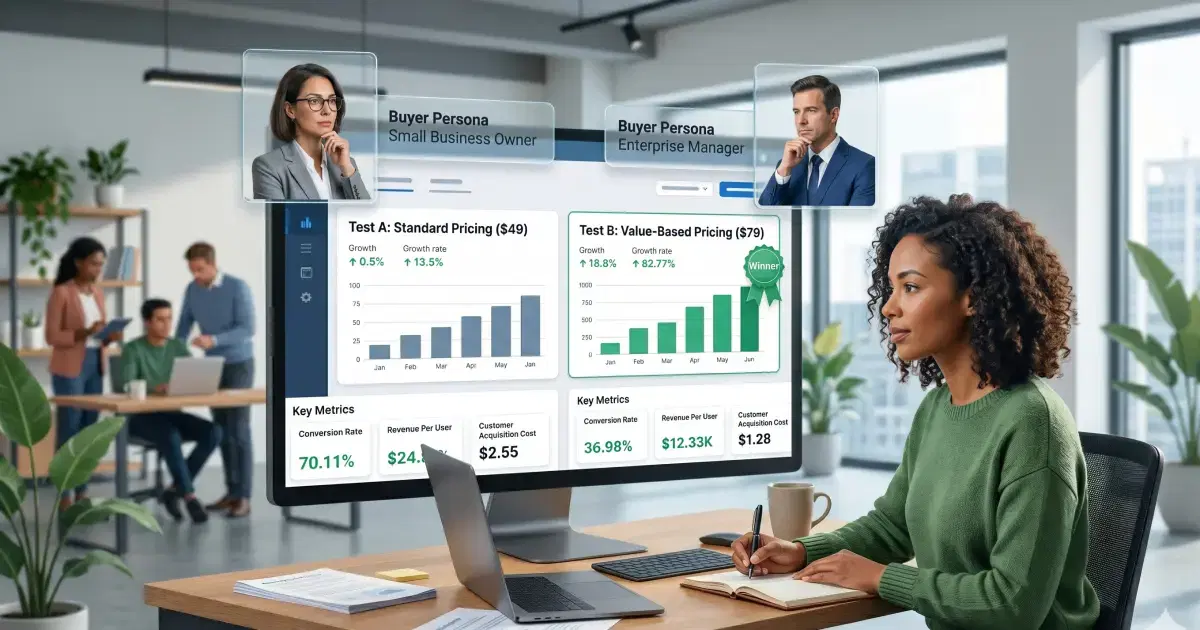
The new landing page draft is open on screen. The product team likes one headline. The founder likes another. The growth lead is somewhere in between.
Is "Stay ahead when everyone builds faster" the one that lands? Or is "Validate before you build the wrong thing" sharper? Should we test both? Should we have written a third option by now?
The decision matters. Get the headline wrong and the rest of the page never gets read. Get it generic and you blend into a market saying the same thing in slightly different words. Get it bold without proof to back it up and you set a promise the next paragraph cannot keep.
So, the call usually comes down to a mix of internal debate, gut feel, and whichever option the loudest person in the meeting prefers.
- "This one sounds more confident."
- "That one feels too narrow."
- "Let's just A/B test it once we ship."
- "What are competitors saying?"
That is normal. But it is not enough. Because a headline is not just a sentence — it is a test of relevance. And the people best positioned to tell you whether that relevance lands are the customers you have already interviewed.
Your buyer is asking:
- "Is this written for me?"
- "Does this understand what I am actually trying to solve?"
- "What does this promise — and can they deliver it?"
- "Why should I keep reading?"
- "What does the rest of this page need to prove?"
That is exactly why your Buyer Persona should be part of the messaging decision.
Until now, most Buyer Personas were used as reference documents. They informed positioning workshops and brand briefs but rarely showed up when the headline was being written. With Talk with Your Buyer Persona, that changes. You can now bring your messaging decision directly to the Buyer Persona you built from customer interviews — and test it against the evidence behind it.
What to Ask Your Buyer Persona
The strongest messaging questions are the ones that surface the reasoning behind a reaction, not just the preference.
A good prompt to start with:
"Which headline is stronger for this audience: 'Stay ahead when everyone builds faster' or 'Validate before you build the wrong thing'?"
A useful answer should not simply pick a winner. It should tell you why one headline lands and the other does not, what promise the winner makes, what the buyer would need to see next, and where both headlines still leave gaps.
Here is what Marcus, a technical co-founder built from real customer interviews, came back with when asked exactly that question:
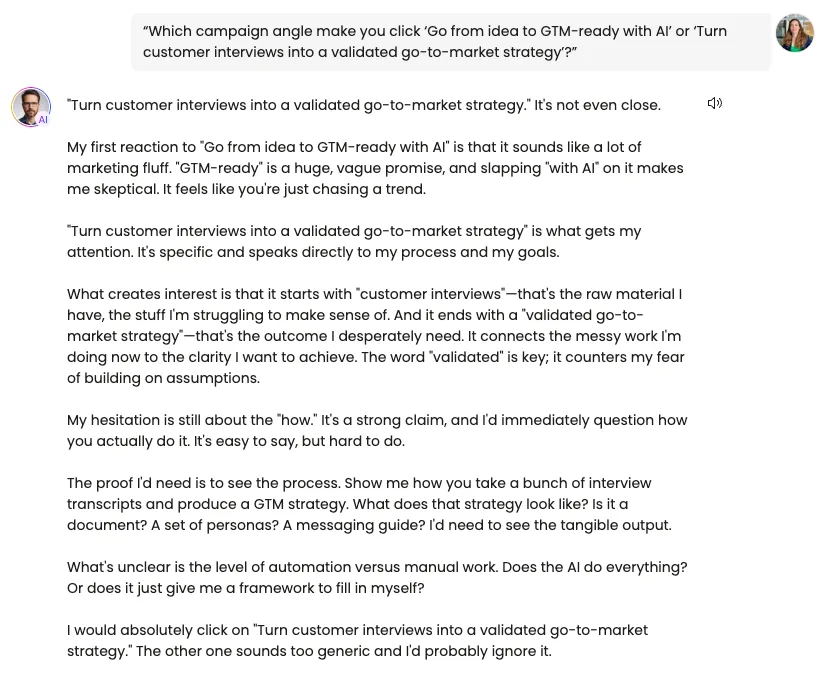
That is not an opinion. That is evidence — the kind that turns a messaging call into a sharper, more defensible decision.
What the Buyer Persona Reveals
Every answer comes back through four lenses. Each one tells you something specific about your message and points to a different next move.
What Creates Interest
The signal: Marcus picked the second headline decisively because it named his actual fear — wasting limited runway building the wrong thing. The first one talked about speed; the second one talked about direction, which is what he is really worried about.
What it tells you: relevance beats aspiration. The winning headline is the one that names the buyer's specific pain in language they recognize — not the one with the most ambitious promise.
The move: anchor the rest of the page on the pain the headline named. If the headline says "wrong thing," the next section should show what going in the wrong direction actually costs — and how the product prevents it. This is the foundation of a strong unique value proposition.
What Causes Hesitation
The signal: Marcus called the winning headline a bold promise and said he would immediately want to know how it is delivered. The same line that earned the click is the one that raises the bar.
What it tells you: a strong headline creates an obligation. The bolder the claim, the more the page has to substantiate it within the next three seconds of reading.
The move: pair the bold headline with a sub-headline that previews the mechanism. Not just "we help you validate" — but "structured customer interviews, AI-synthesized insights, a Buyer Persona built from the evidence." Show the how before the buyer scrolls.
What Proof Is Missing
The signal: Marcus directly asked to see the validation process in action. He wants to know what it looks like, whether it is structured, what the experience actually involves.
What it tells you: at this level of promise, the buyer is not satisfied by description. They want to see the process — the steps, the structure, the artifact at the end.
The move: put the process on the page. A short visual walkthrough of the four or five steps. A screenshot of a finished output. A 30-second demo of the validation flow. Make the abstract concrete before the buyer leaves the page.
What Still Needs to Be Tested
The signal: Marcus said both headlines leave it unclear what "it" actually is. A tool? A service? A course? The winner earned the click, but the category is still ambiguous.
What it tells you: the headline does the positioning work. It does not do the categorization work. Those are two different jobs, and the page is missing the second one.
The move: test two versions of the sub-headline — one that explicitly names the category ("the AI co-founder for validation"), one that does not. See whether category clarity speeds up scrolling or slows it down. Let real prospects tell you which one converts.
What to Do with the Answer
This is where the feature becomes useful. The goal is not to let the Buyer Persona pick the headline for you. The goal is to understand what must be true for the headline to convert.
In Marcus's case, the headline contest already has a winner — "Validate before you build the wrong thing". But the answer goes further than that. It tells you the winning headline is a bold promise that needs structural support: a sub-headline that previews the mechanism, a section that shows the process, and a sentence that names the category.
If you had only the four lenses without the worked example, you would be left with categories. With the worked example decomposed, you are left with four specific moves for the landing page: anchor on the pain the headline named, preview the mechanism in the sub-headline, put the process on the page, and clarify the category.
This is the shift. The Buyer Persona is no longer just describing the customer. It helps you understand how the customer evaluates your message — and what the page needs to do next.
The Real Value of a Buyer Persona Starts After It Is Created
A Buyer Persona should not sit in a deck after the research is done. It should come back when the decision gets hard. Messaging is one of those decisions. Pricing, features, campaigns, sales pitches, and website copy are others.
That is why Talk with Your Buyer Persona matters. It turns customer research into a practical decision workflow.
How Your Buyer Persona Becomes Someone Worth Talking To
Your Buyer Persona is only as useful as the customer evidence behind it. So, before you talk to it, build it on a foundation that earns the conversation.
Inside Icanpreneur, you start by defining the customer segment you want to understand. From there, IVA helps you generate a research script designed to uncover what really drives buying decisions — priority initiatives, success factors, perceived barriers, the buyer's journey, the criteria they actually use to choose.
You can start fast with synthetic interviews. IVA runs five of them in your selected language, gives you an initial Buyer Persona, and gets you moving the same day. That alone is enough to start asking questions that would have taken weeks to answer otherwise.
But here is what makes the difference: your Buyer Persona is not a static document. It is a living artifact that updates with every new interview you add. Talk to real customers. Add their interviews to the same research. Your Buyer Persona evolves — and the answers you get when you talk to it get sharper, more grounded, more specific to the people you are actually building for.
Synthetic interviews give you the signal to start. Real customer interviews turn that signal into evidence you can stake decisions on. The Buyer Persona becomes more useful the more interviews you do.
So, if your Buyer Persona is talking back with vague answers, it is not the feature. It is the evidence base. Add the next interview. Then ask again.
Messaging is one of the decisions you can talk to your Buyer Persona about. It is not the only one. The decisions that follow — features, campaigns, sales pitches, websites — get sharper for the same reason. Every one of them is a question your customers have already answered, sitting in a workspace you have already built.
Your Buyer Persona used to help you describe the customer. Now it helps you decide what to do next.
Bring your next messaging decision to your Buyer Persona. Try it free at meetyourbuyer.io
Author
 Vesko Kolev
Founder & CEO of Icanpreneur. Passionate about connecting people with their purpose of becoming successful entrepreneurs.