More customer interviews only create an advantage if you can turn them into insight that keeps informing the decisions that follow.
Customer insight has always been one of the strongest foundations for good strategy. The challenge is that getting enough of it takes time, and the more customers you speak to, the more difficult it becomes to analyze the conversations with the same level of depth and consistency.
That was the situation Sebastian Schneider faced when working with a set of 20 customer interviews. The volume of customer input was valuable, but processing it manually would have required a significant amount of time before the findings could actually be used to inform the next decisions.
As Sebastian puts it: "Icanpreneur handled a volume I never could."
The value, however, wasn't simply processing more interviews. It was being able to turn that volume of conversations into structured customer insight without sacrificing the quality of the analysis.
The Bottleneck Isn't Collecting Customer Feedback. It's Turning It Into Insight.
Today, any LLM can summarize a customer interview. You can upload a transcript into Claude or ChatGPT and get themes, pain points, and a neat summary within seconds.
However, summarizing the conversations is only the first step. The real value comes from understanding which patterns repeat across interviews, which customer problems matter most, which assumptions are actually supported by evidence, and how those findings should change the way you think about the buyer.
That's where Icanpreneur fits into Sebastian's workflow. Instead of treating each interview as an isolated piece of research, Icanpreneur helps turn the conversations into a structured body of customer evidence that can be analyzed, synthesized, and used to strengthen the Buyer Persona.
The workflow looks something like this:
Customer interviews → insight analysis → Buyer Persona → product and GTM decisions
The research therefore doesn't end with a summary. The customer insight becomes part of the context that informs the decisions that follow.
From More Data to Stronger Customer Understanding
That distinction matters because more client conversations do not automatically lead to better decisions. The advantage comes from a richer understanding of the customer that can then inform the Buyer Persona and ultimately the product and GTM decisions that come next.
Instead of starting each strategic question from scratch, the team can keep building on what has already been learned about customer pain points by simply talking to the Buyer Persona. It represents the collective insights and client understanding from all customer conversations, and it answers based on all the gathered and analyzed evidence.
Scale Matters. But Not at the Expense of Insight Quality.
AI has made it much easier to process large amounts of qualitative information. But speed alone is not enough if the output becomes shallow or disconnected from the rest of the strategic work.
What matters is being able to scale the research while preserving the quality of the customer insight.
That is the real value behind Sebastian's use case. Icanpreneur does not simply reduce the time required to process customer interviews. It turns the findings into structured customer intelligence that stays connected to the Buyer Persona and can continue informing the decisions that follow.
This is particularly important when teams or consultants are working with larger volumes of customer evidence, because the challenge is to make sure those insights remain usable after the research phase is over.
The Buyer Persona Shouldn't End as a Research Document
Customer research often follows a familiar pattern. Interviews are conducted, the findings are summarized, a Buyer Persona is created, and then the research is gradually left behind as the team moves into product, positioning, messaging, or GTM execution.
But the value of the customer insight should not stop when the research is complete.
At Icanpreneur, we see the Buyer Persona as more than a research deliverable. It is a living representation of what has been learned about the customer and a way to keep that understanding present when the next strategic decision is made.
The interviews create the evidence, Icanpreneur structures the insight, and the Buyer Persona carries that understanding forward into product and GTM decisions. The human still makes the call, but there is significantly more customer intelligence behind it.
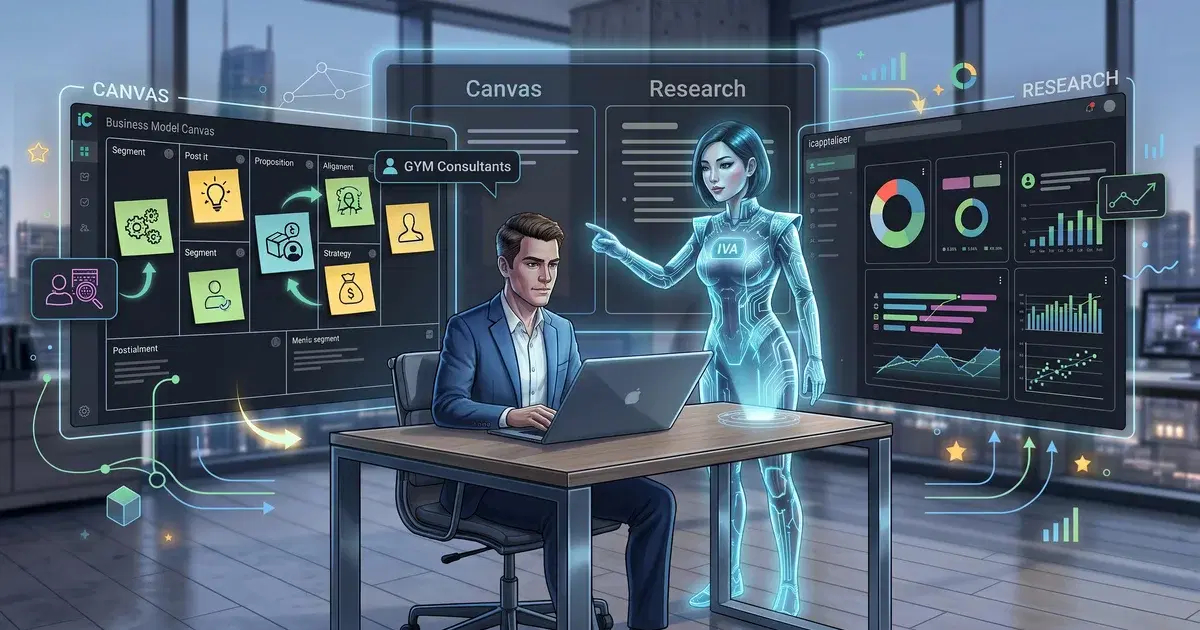
You can now also work through research findings with IVA directly inside Research, turning them into product and GTM decisions.
AI Can Analyze Interviews. That's Not the Competitive Advantage.
That's the broader shift we see happening as AI becomes part of every research, product, and GTM workflow.
Everyone increasingly has access to the same AI models, and everyone can upload transcripts and ask an LLM to summarize what customers said. The competitive advantage therefore comes from turning proprietary customer evidence into structured intelligence that accumulates over time and stays connected to the decisions that follow.
Sebastian's case illustrates that difference clearly. The value is not 20 interviews → faster summary, but rather 20 interviews → stronger customer insight → richer Buyer Persona → better-informed decisions.
As AI commoditizes more of the analysis and strategy-production process, that distinction will only become more important. The model may be available to everyone, but the customer evidence behind the decision is not.
And that's where we believe the next generation of AI-assisted decision-making starts: with customer insight that is structured, cumulative, and ready to inform what happens next.
Watch Sebastian's Story
See how Sebastian Schneider uses Icanpreneur to turn a large volume of customer interviews into structured customer insight that can continue informing the Buyer Persona, product choices, and GTM decisions.
Icanpreneur helps turn customer conversations into customer intelligence that stays connected to the decisions that follow.
Author
 Emil Tabakov
Product @ Icanpreneur. Coursera instructor, Guest Lecturer @ Product School and Telerik Academy. Angel Investor. Product manager with deep experience in building innovative products from zero to millions of users.