One of the things that I love most in my job is the depth that we get into everything that we do. We need to deeply understand the internal mechanics of everything that makes or breaks a business while at the same time operationalizing it through an AI-first software system that enables effective collaboration between teammates and IVA - the AI co-founder inside the platform.
In the last months I joined an exceptional community of product marketers - Product Marketing Alliance. As part of that we discussed the question "Do you start with the ICP or the buyer persona?" which turned out to be a great debate. There was a feeling that there are two camps:
- Camp 1: ICP first, then personas. Define the companies you serve best, then build the buying group inside that. A head of procurement at a tech company is not the same as one at a bank, so cluster your personas by ICP and update them as campaign data comes in.
- Camp 2: treat the ICP as a hypothesis. An ICP approximates the ideal account. The persona explains why people actually buy. Validate with interviews, ideally 12 to 20 people who evaluated a solution in the last 6 months, before reaching for statistical significance.
So which camp am I in? Here is the expanded view that I've shared in the community, as-is. If you like the depth, I strongly advise you to join it yourself.
Two Camps or One Picture?
I actually don't think that there are two camps as ICP and Buyer Personas are deeply interconnected. The biggest reason why we have such debates at all, in my view, is because many times we are looking at it from a mature product/company perspective. The discussion typically starts with "Look at your best customers and try to find more of them". This can happen in a known market with a known customer and a known value prop. This is what makes it feel like that ICP is first and then buyer persona is pointless as we already know what we need to know - why they buy, what they pay, etc. There is one big BUT here, that I will share at the end, so keep reading :).
Start with the Customer Segment
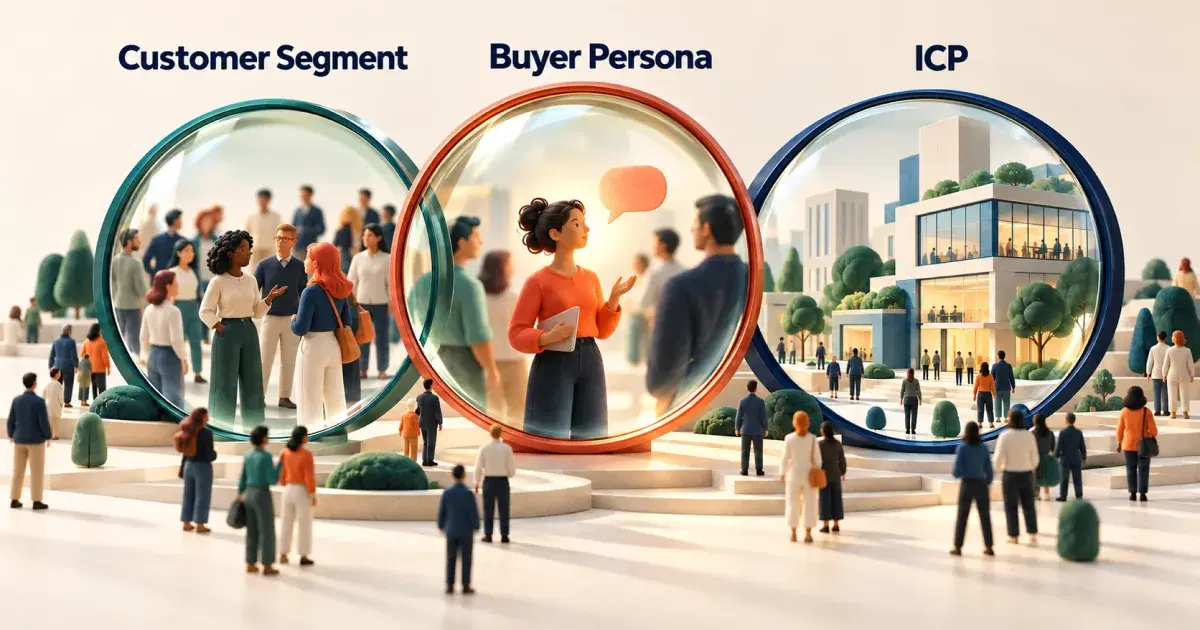
And so, to see the full picture clearly, we need to explore the case when a company or a product is in its inception. It all starts with an assumed Customer Segment and one or more Customer Problems. You can think of the customer segment as a very high-level, broad description of the ICP in terms of company/organisation as well as a specific role in it who is supposedly the person who is accountable for addressing that problem.
At that point the first thing that you need to validate is whether the assumed segment has these problems at all or to discover others. You do that by exploring the related Job-to-be-Done that the customers in your assumed segment aims to get done as related to your customer problems. In that exploration it is very likely to start seeing a person in one company to have a given problem while a person in a smaller/bigger company to have other problems or no problems at all.
As an example - think CRM. When you have 2 sales people you can probably manage whatever workload you have with a shared spreadsheet. But when the number of sales reps goes let's say above 5, the Spreadsheet solution breaks as the complexity and the required context that needs to be shared becomes unmanageable with that solution.
So What Is an ICP?
ICP is a set of company characteristics that makes it highly or more likely for a given job-to-be-done to arise in the life of specific people with a specific role in those companies. Most of the time it is a correlative rather than causative relationship. And sometimes (definitely not always!) there are certain signals that can be used to detect that the job-to-be-done arose. It is a signal for market entrance.
One great example - when you go to take your new born baby from the hospital, you get a set of cosmetics from specific brands as a gift. That's an unbelievably great, clear market entrance. Yet, most of the time we don't have such luxury and we need to use imperfect, suggestive signals.
How Do You Get to an ICP Without Customers?
So how do you actually get to an ICP when you don't have customers at all? You do that by starting with a hypothesis (the assumed customer segment) then you validate it with problem discovery and validation to prove or disproof your assumptions for problems and value prop and then when you have enough interviews you will typically see sub segments. We say 10-12 interviews are typically enough IF you talk with the right representative of the ICP. But at that early stage, you don't have that clarity yet, so you have to explore and discover/define these.
Then Comes the Buyer Persona
Once you have that, i.e. validation of customer segment-customer problem fit, then you do buyer persona interviews. They help you specifically discover the causation of the search for a solution (i.e. triggering event), how people actually search for such a solution, what their search criteria are, how success looks like, etc. Without that knowledge you cannot have positioning, messaging and go-to-market strategy that is grounded in customer insight. I challenge you to prove me wrong on that one.
The One Big BUT
Finally, going back to the promised "one big BUT". Very often, in the context of a mature product/company, it feels like we can just use ICP and explore our existing customers without doing buyer persona interviews. However, the hidden underlying assumption of that approach is that your market is static and that you know everything about your customers and what their buying behaviour is.
Just ask yourself - in the age of AI, which markets are actually static? Do the needs of your customers as well as their expectations evolve or stay the same? I know you already feel my view - none.
So my personal opinion is that if you want to lead the pack and not just be a follower that replicates, you need to consistently gather first-party data as a product marketer. Yes - sales and support convos are valuable, but they are not designed and intended to answer the questions that you need to answer in order to be great at what you do.
P.S. That is why I consistently suggest people who are looking to do product marketing to start their own thing while searching for a job - this is the full scope "game" where you can feel what it means to start from nothing and to get to something. Probably (one of) the hardest but most satisfying jobs in the world.
Author
 Vesko Kolev
Founder & CEO of Icanpreneur. Passionate about connecting people with their purpose of becoming successful entrepreneurs.